Spoke stretch isn’t entirely new to the app. For some time now, both the free spokecalc.io and the calculator engine inside the SpokeCalc app have included stretch estimations as part of their length calculations.
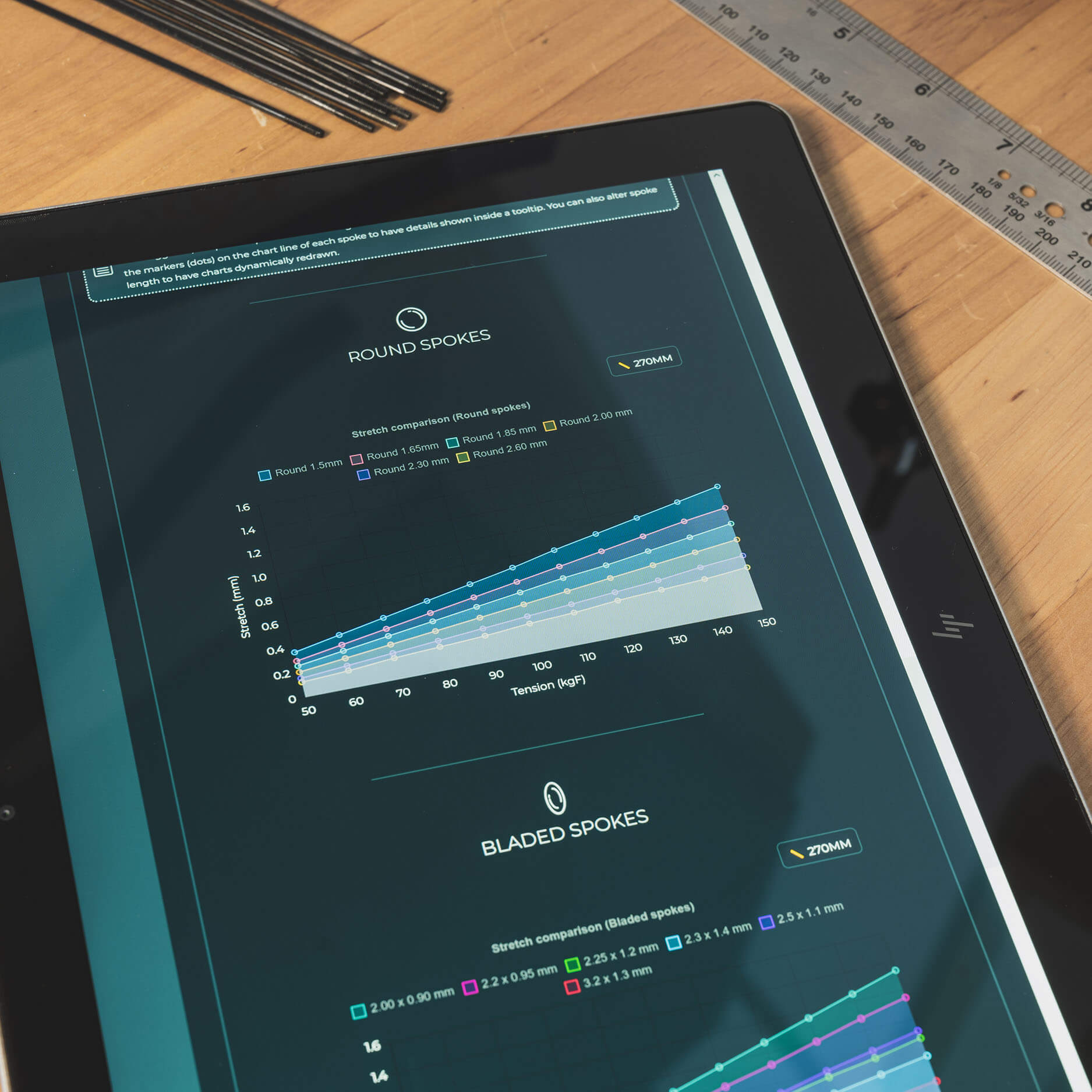
But only recently, dedicated elongation charts for user-saved spokes inside the My Components page were introduced with a side-to-side comparison feature. But what’s more intriguing is the interactive comparison tool to visualize common spoke types and shapes together. Are you eager to explore how popular round or bladed spoke models compare to one another in terms of elongation?
In the following article, we’ll dive into:
- What spoke stretch actually is,
- Why it matters for spoke length and tensioning,
- How different materials & shapes behave,
- And finally, how the new app tools (Elongation charts, Rounding Suggestions) can help you make smarter choices for your builds.
About spoke stretch
Spokes don’t just hold a wheel together; they stretch under tension. A feature, most wheel builders are either not even fully aware of, or casually ignoring it at the other extreme, especially beginners. That stretch may be small in absolute numbers, but it inherently defines how a wheel feels on the road or trail. More importantly, from a wheel builder’s perspective, spoke stretch directly affects the build itself, with the correct spoke length choice being just one of the implications.
So what is it all about? Elongation — or spoke stretch — is the elasticity property of a spoke under tension. It describes the degree (in mm) to which a spoke lengthens when subjected to a specific force (e.g., tension in kgF). Just as a reference, performance-based stainless spokes stretch up to or even exceed a full millimetre at common working tension ranges of 100 kgF and above. And such a difference can quickly mess up meticulously planned spoke length calculation, agree?
Knowing a spoke’s material and dimensions provides enough information to estimate elongation across different spoke types and profiles, as mathematically, elongation depends on several factors:
- Cross section of the spoke — a larger surface area reduces elasticity
- Spoke length — longer spokes stretch more in absolute terms, though proportionally less (the Stretch Factor)
- Material properties — material constants, such as Young’s Elastic Modulus, define the rate of stretch
- Force applied — tension does not increase stretch at a strictly linear pace
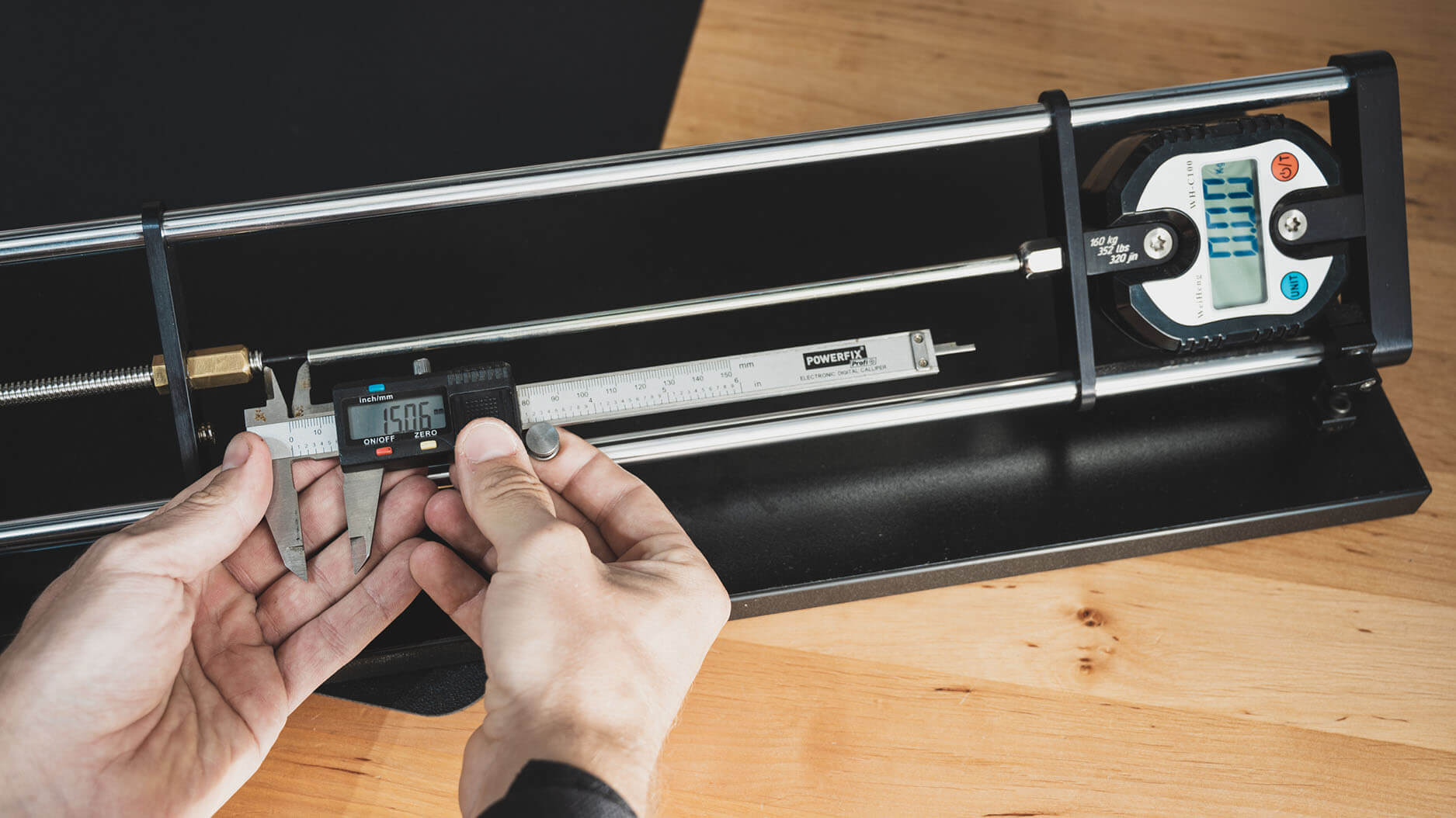
Even small changes in shape or diameter can significantly alter spoke behaviour under load. For wheel builders, this is a property worth handling with caution — especially when working with thinner, performance-focused spoke types.
Spoke stretch chart
Since spoke elasticity does not increase linearly when applying force to the spoke, a recent update to the app introduced dedicated elongation charts inside the app’s component library to better understand the stretch of a particular spoke.
These charts let you see how a spoke behaves under tension — not just the magnitude of its stretch, but also how that stretch depends on the load applied, represented by the steepness of the curve.
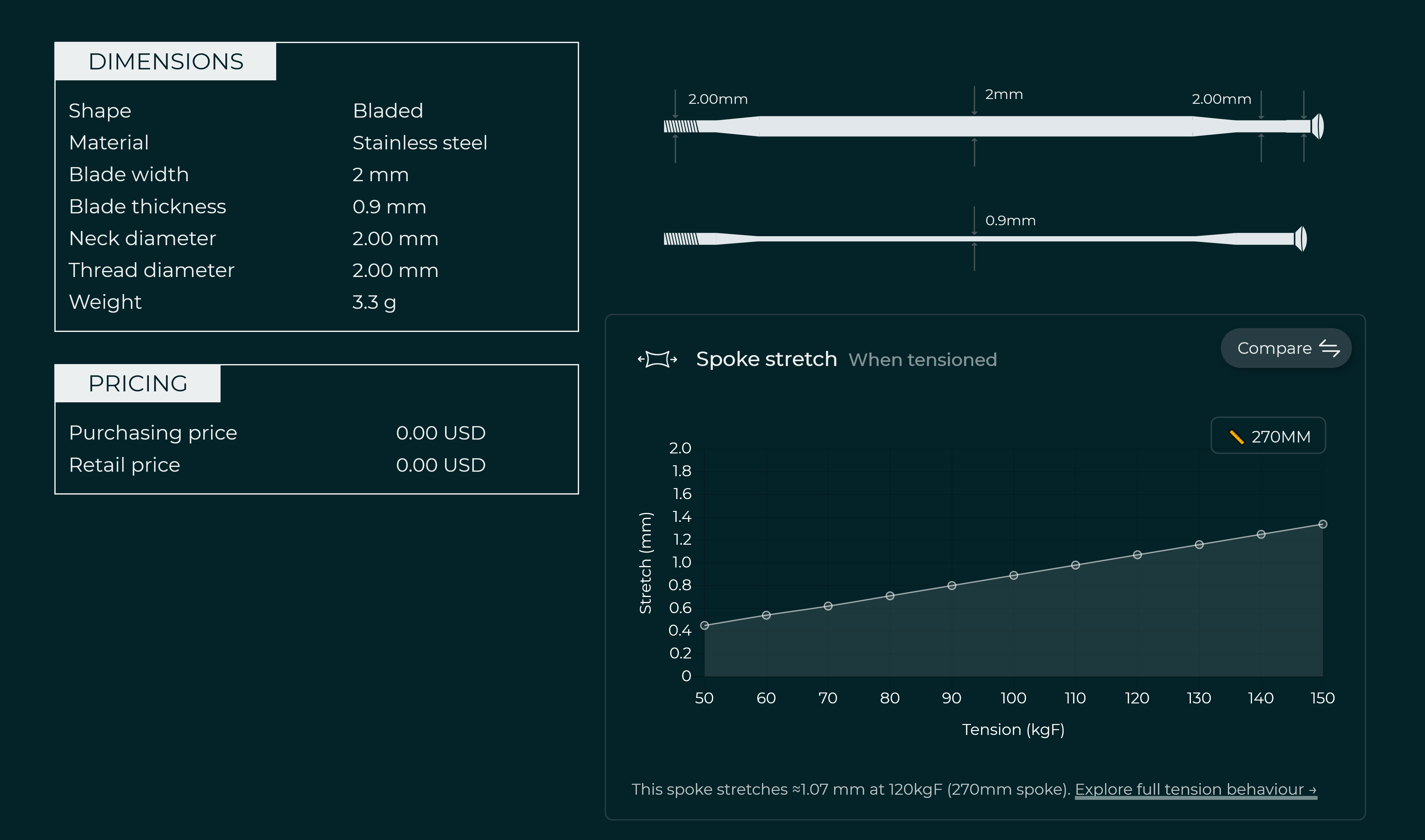
The chart even lets you pick a spoke length (top-right) and see exactly how much that spoke stretches as tension increases.
Moreover, you can also compare the selected spoke against one additional spoke model, making it easier to spot differences between materials, diameters, or shapes you’ve stored in your component library.
But why is being aware of spoke elasticity properties so important?
Why predicting spoke stretch is useful
Spoke stretch is not just a theoretical number — it has direct implications for both the build process and the final wheel performance in a real build. And that explains why I’ve received so many “It’s for sure an eye-opener!” comments since introducing the spoke elongation feature inside the SpokeCalc calculator.
Even though the absolute stretch values may look small on paper, not knowing them will force you towards a blind decision when rounding up or down the calculation. Get the spoke length wrong by a fraction, and elongation under load might cause a nipple bottoming out, and you running out of threads. Having accurate stretch data helps you avoid those frustrating moments we've all experienced before.
Stretch also affects how a wheel comes together on the stand. Softer, more elastic spokes tend to be finicky - spoke tension builds at a slower pace, and you will inevitably experience several tension drops during the de-stressing process. If you’re used to stiff plain-gauge stainless setups, this can come as a surprise: the familiar routine of turning nipples and chasing even tension suddenly feels less predictable, with the wheel pulling out of true more easily.
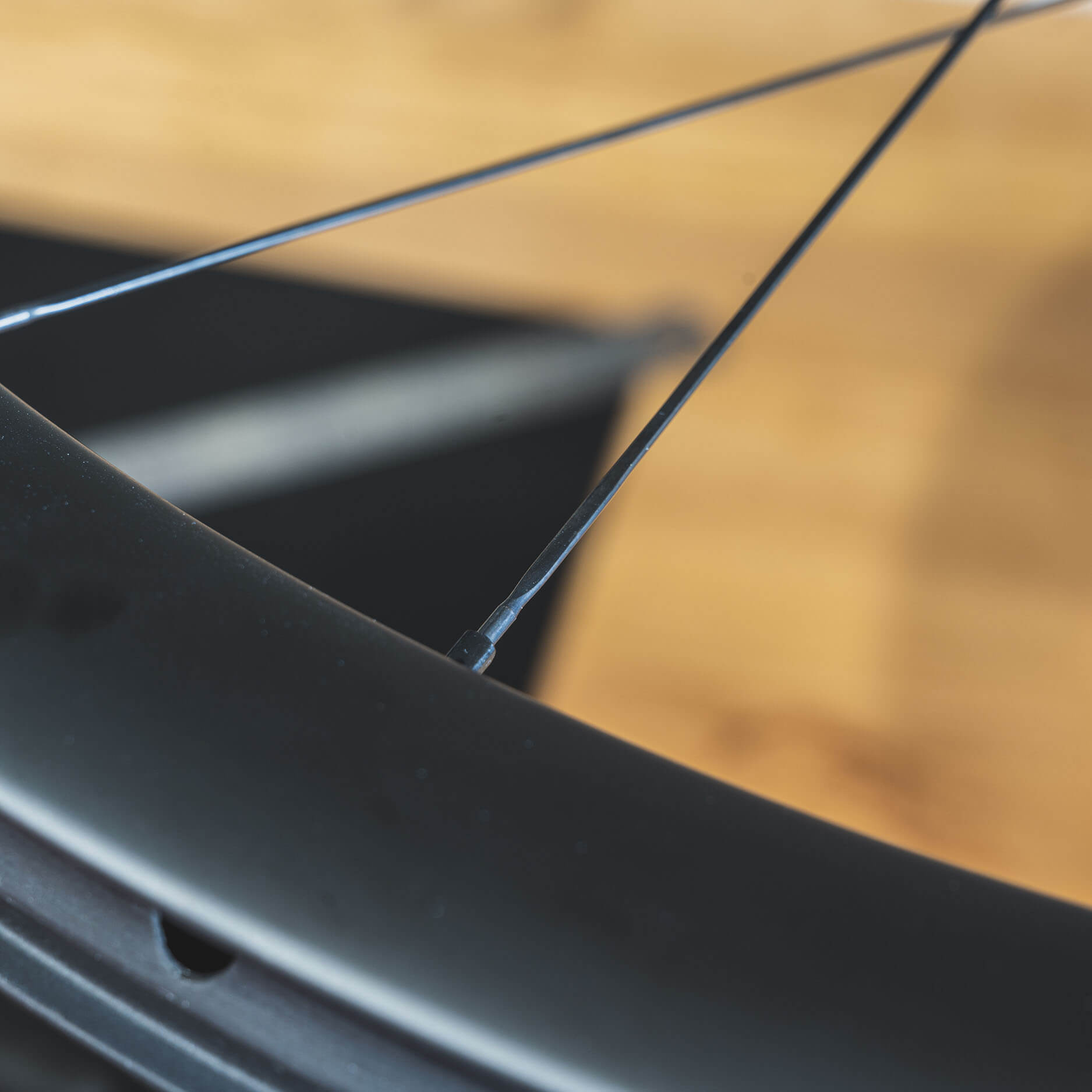
Let's switch our attention from a work stand to the "road". Another aspect is long-term serviceability. Overly stretchy setups usually lead to more frequent re-tensioning, while overly stiff ones can be less forgiving under impact. Knowing where your spokes sit on that spectrum helps set the right expectations for maintenance. And, communicate them transparently to the rider!
Finally, stretch even opens up room for strategy. Some builders deliberately mix spokes — for instance, using slightly stretchier spokes on the non-drive side of the rear wheel to balance tension and improve durability. Since many builders experiment with mixing stretchier spokes on the side with the lower tension, I added a feature in the app to choose spokes separately for each side of the wheel. It’s a subtle detail, but one that shows how understanding elongation can give you more control over both the build and the ride.
From an engineer: "Thinner spoke experiences a higher tensile stress for the same amount of tensile force and thus has a larger amount of strain, or stretch, and therefore will not experience as much flex at the bend when de-tensioned at the bottom of the wheel."
Spoke shapes and cross sections
One of the most impactful factors behind a spoke’s elasticity is its cross-sectional profile. Essentially the size of the area in mm² that resists stretching. A small change here can have a surprisingly large effect. For example, a 2.0 mm round spoke is already much stiffer than a 1.5 mm one, even though the diameter difference doesn’t look dramatic at first glance.

Inside the app, bladed spokes are treated as wing-type profiles, meaning their cross-section is calculated as an ellipse rather than a rectangle with rounded edges. This gives a more realistic picture of their actual behaviour under tension.
Double-butted spokes demonstrate the clever use of cross-section to balance strength and elasticity. Their thinner mid-sections allow for a lower weight and controlled stretch in the spoke body, while the thicker ends remain strong where stresses are highest. Bladed or aero spokes, on the other hand, behave less intuitively. A flat wing-type section may resist elongation differently from a rounded “aero” profile, even if both share similar weight on paper.

Even small differences in parameters for cross section calculation (like diameter) can shift how a spoke behaves when force is applied. The new comparison tool lets you overlay multiple spoke profiles side by side to see how changes in spoke shape affect estimated stretch.
That’s why even small parameter differences — like half a millimetre in diameter — can shift how a spoke behaves under load. To make this clearer, the new comparison tool lets you overlay multiple spoke profiles side by side and directly see how changes in shape and size affect elongation.
What about spoke material?
Spoke material
With stainless steel still claiming the title of the most popular spoke material, wheel builders are nowadays encountering other materials that behave noticeably different. Inarguably, each brings its own elasticity properties into play, captured by its Young’s Modulus.
The Young's Modulus (or Elastic Modulus) is in essence, the stiffness of a material. In other words, it is how easily it is bent or stretched. Having all inputs of the base elongation formula intact, The Young's Modulus describes the rate of elasticity of a material:
- Stainless steel:~210,000 MPa (industry standard, used for most spokes like Alpina, DT Swiss, Sapim, Pillar, etc.).
- Titanium: ~110,000 MPa — almost half that of steel, meaning titanium spokes stretch much more under the same load.
- Aluminium: ~70,000 MPa — even lower, which makes them less common for spokes due to excessive stretch and fatigue issues. Spokes are often made oversized compared to stainless steel to compensate.
- Carbon fibre: varies widely (anisotropic), so a single number cannot capture it. Properties depend on fibre type, resin, and fibre orientation. All in all, carbon spokes should elongate less. You cannot "stretch" a carbon spoke like a steel one by applying high tension. Carbon fibres are brittle and will fail catastrophically if over-tensioned.
The lower the Young's Modulus, the greater the expected elasticity for the same cross-section of a material. This puts things into perspective: even small differences in modulus can have a big impact on elongation behaviour and, ultimately, on wheel feel and durability.
Note: Modern, advanced materials (such as carbon fibre spokes, Pi-Rope, or Berd textile spokes) are often composites and therefore anisotropic, with their properties varying significantly in different directions, which introduces complexity. Theoretical estimates become just assumptions; however, real-life data testing for each material is still necessary to provide useful approximations.
Stretch factor
Sticking to the elongation formula gives us a stretch value in millimetres — an absolute number. Useful, yes, but not quite enough when it comes to comparing spokes.
On the contrary, normalising spoke elongation by introducing the Stretch Factor (% of stretch per mm) metric puts it into perspective by relating stretch to spoke length. Longer spokes stretch more in total, but their stretch per millimetre of length is smaller. This applies also vice versa, where shorter spokes show less total stretch, but their relative stretch factor is larger.
Due to complex nature of elongation formula, the stretch rate is not linear, therefore also the stretch factor is not uniform for a spoke model across tension range.
Results: Common spoke types & shapes
We’ve arrived at the interesting part at last - actual numbers as a result of comparing common spoke types and shapes. The following section lets you compare whole spoke categories side by side. This is where you can really see how different shapes influence stretch under load.
There are two charts below, each representing the most common spoke types of the same shape – round and bladed. By normalising the curves across equivalent spoke lengths, those two charts highlight which profiles are more resistant to elongation and vice versa (i.e., relative stiffness).
This broader overview makes it easier to understand why certain spokes are favored for performance builds, while others offer more forgiving characteristics for durability and ease of truing.
TIP: Toggle on/off specific spokes inside the legend above the chart to have them shown or hidden. Hover over the markers (dots) on the chart line of each spoke to have details shown inside a tooltip. You can also alter spoke length to have charts dynamically redrawn.
ROUND SPOKES
Sample Stretch – Round Spokes, Stainless steel (120 kgf, 270 mm)
| 1.50 mm | 1.65 mm | 1.80 mm | 2.00 mm | 2.30 mm | 2.60 mm | |
|---|---|---|---|---|---|---|
| Stretch (mm) | 0.86 | 0.71 | 0.59 | 0.48 | 0.36 | 0.29 |
| SF (% of length) | 0.32 | 0.26 | 0.22 | 0.18 | 0.13 | 0.11 |
BLADED SPOKES
Sample Stretch – Bladed Spokes, Stainless steel (120 kgf, 270 mm)
| 2.00 x 0.90 mm | 2.20 x 0.95 mm | 2.25 x 1.20 mm | 2.30 x 1.40 mm | 2.50 x 1.10 mm | 3.20 x 1.30 mm | |
|---|---|---|---|---|---|---|
| Stretch (mm) | 1.07 | 0.92 | 0.73 | 0.70 | 0.60 | 0.46 |
| SF (% of length) | 0.4 | 0.34 | 0.27 | 0.26 | 0.22 | 0.17 |
What conclusions can we takeaway studying spoke elongation across common spoke types of each category (round, bladed)?
- Not all spokes stretch the same — profiles, dimensions, and materials each change how much a spoke elongates under tension.
- Stretch is not linear — the higher the load, the faster elongation grows. Lines therefore start coming apart noticably as tension rises.
- Round vs. bladed — for round spokes, increasing diameter improves stiffness. For bladed spokes, thickness (not width) has the stronger effect on resisting elongation.
- Spoke length matters — shorter spokes show a higher stretch factor (more elongation per mm of length) but less absolute stretch, while longer spokes elongate more overall but relatively less.
- Practical build implications — some spokes allow finer tension adjustments, while others demand slower, more cautious tensioning to avoid losses during stress-relief.
- Stretch factor awareness — understanding elongation helps when deciding between two spoke lengths that calculate close together, reducing guesswork.
Bonus: Too much tension?
Exploring in-depth about spoke elasticity made me wonder about another problem builders might face. Too much tension. As it appears, while spoke stretch is an elastic property, where the spoke returns to its original length once tension is released, this is only true up to a certain limit.
This limit is known as the yield point, and basically, it is a point of no return. Push a spoke beyond such a point and theoretically material stops behaving elastically, meaning it won’t fully spring back. Instead, it stays permanently elongated, weaker, and prone to fatigue.
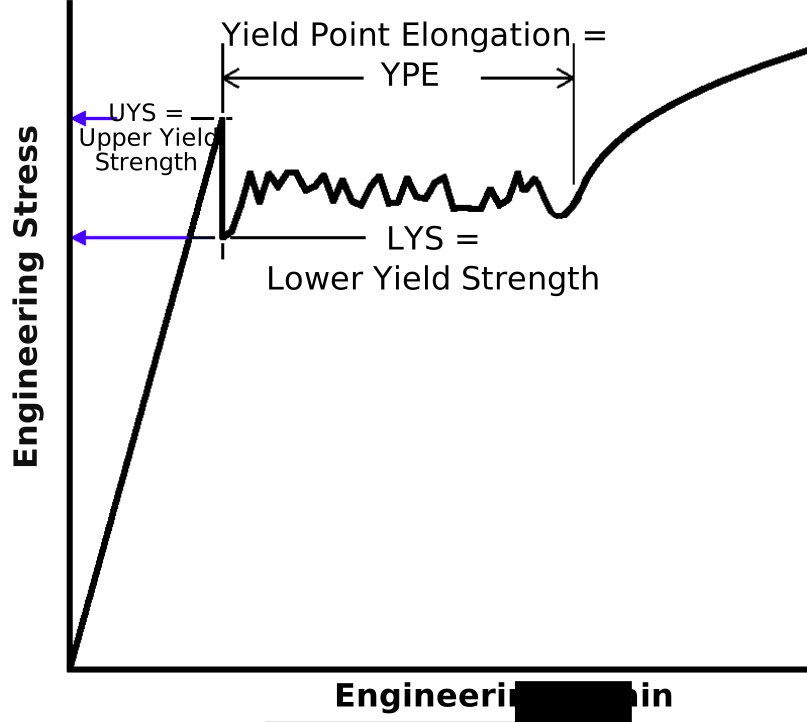
This is why extreme tensions are risky. Once you go past the yield zone, no amount of re-tensioning the wheel will help restore the spoke’s original strength, as material is permanently damaged.
Besides the myth of tension increasing the stiffness of the wheel, this is another reason why I actually don’t advocate high tension setups.
Rounding suggestions
When it comes to spoke calculation, choosing the right spoke length is rarely straightforward, especially when being stuck between two available spoke lengths. In such situations, assuming you don’t own an expensive spoke-cutting machine, rounding up or down blindly can have real consequences.
A spoke that is too long risks protruding past the nipple, bottoming out on the threads, or even damaging rim tape. Too short, and it may not engage enough threads, leaving the build weaker by putting excessive stress on the nipple.
Note: Inside the app’s Spoke Calculator, spoke stretch is estimated but not directly factored into the final spoke length calculation. Instead, it’s displayed separately, leaving the decision in the builder’s hands.
Integrating the spoke stretch inside the spoke calculator sparked an idea of the all-new Rounding Suggestions. The new Rounding Suggestions feature breaks down the decision process and guides you toward the smarter choice. It takes into account:
- The raw calculated spoke length
- The estimated spoke elongation based on spoke properties
- The range of available spoke lengths from suppliers (e.g. only even or only odd lengths)
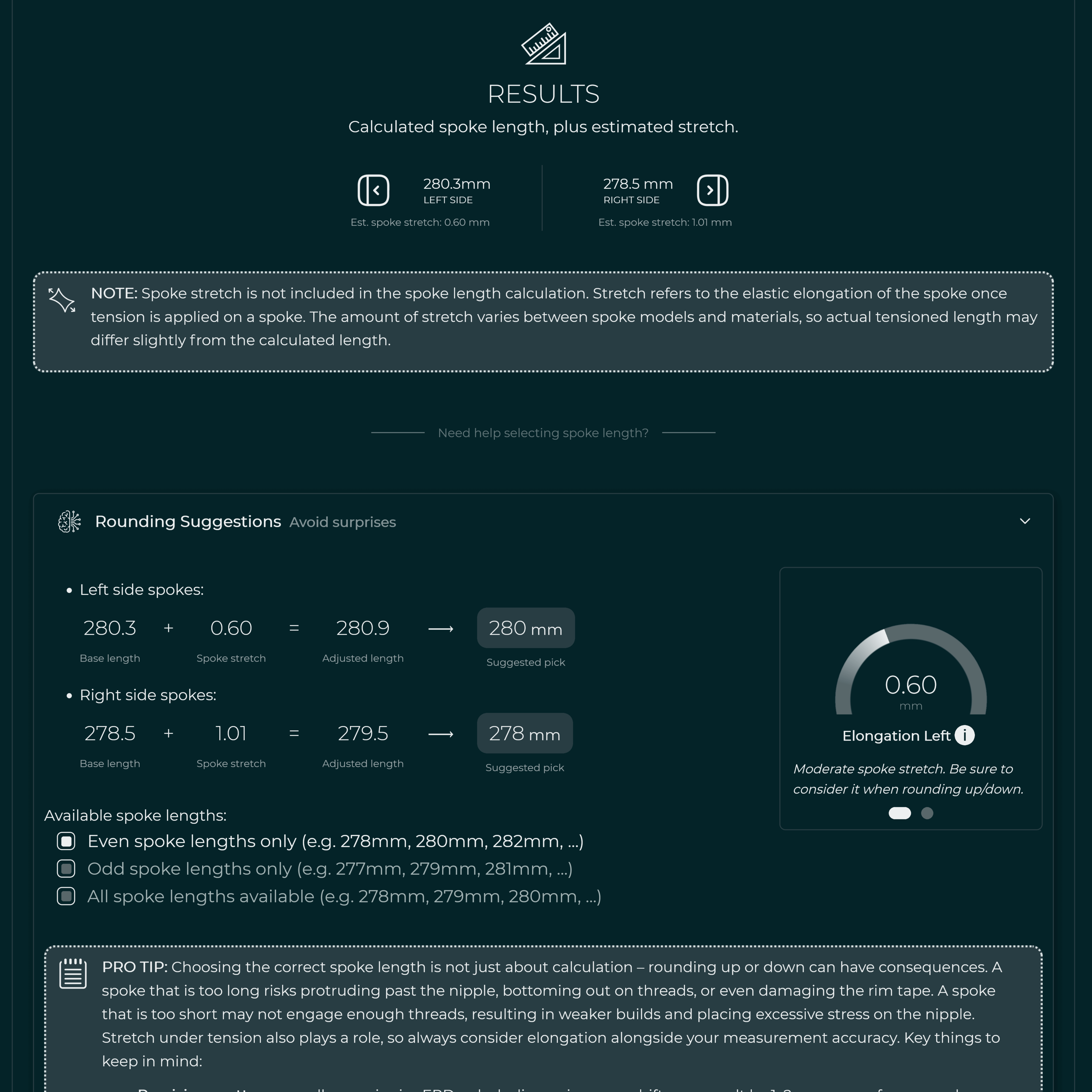
With its suggested pick, the tool helps you tip the balance between rounding up or down and gives you confidence in choosing the correct spoke length for your project.
FINAL THOUGHTS
Unless you are mainly repeating builds that include stiff and thick spokes, you have most likely encountered spoke stretch and its implications somewhere along your builds. Hopefully, not in a way that required a costly rebuild using a different spoke length.
But seriously, just by being aware of the impact it might have especially when using thinner, more performance based spokes, can help you steer in a right direction when picking a spoke length and tactically choose the most appropriate spoke model for the purpose, based on its expected behaviour under tension.
By having all common spoke models in one place and comparing them side-to-side, the new app’s feature will definitely “open” few more eyes amongst wheel builders, eager to have read this article. Enjoy building wheels!
Enjoyed this article?
Buy me a coffee to support my work!
☕ Buy me a coffee
Every coffee helps fuel more content like this!
About author

Aljaž Trenta
Author and founder"As a cycling enthusiast, bike mechanic and self-taught web designer, combining several of my passions and skills to build SpokeCalc was a great fun for me."