Is ERD contaminated?
If you are an avid wheel builder like myself, by now you have most likely figured out exactly what I am talking about. When discussing about confusing wheel building measurements almost always there is one or another problem with the infamous ERD. For the algorithm behind every spoke calculator, a massive part of determining the correct spoke length is using the correct “Effective Rim Diameter” (ERD).
Having fallen into the trap of using online-based ERD data only to later find out that the data was not suitable for the purpose, led me to write about the controversy that this intriguing topic engenders.
Ironically, it looks like everybody uses the same terminology and at the same time means different things. Talking to a fellow wheel builder, he commented »It is a drama because you never know what manufacturers talk about.« No wonder everybody doubts every piece of data available online and prefers taking wheel building measurements on their own.
With all the complexities that arise around this measurement, it seems that the term ERD could very well be contaminated. Furthermore, ambiguous terminology only undermines the validity of online measurements in general.
But, when and why exactly did we put ourselves into such a confusing situation?
VALIDITY OF ONLINE WHEEL BUILDING MEASUREMENTS
I have covered the ERD topic multiple times before, most recently in my article Validity of online measurements – Can you trust web-based wheel building dimensions and even there, I just scratched the problem.
“The next thing is terminology. Although 99.9% of measurements are widely accepted wheel-building terms with clear and meticulous definitions, some manufacturers still use confusing or misleading designations of some measurements. Terms like effective rim diameter, pitch circle diameter, spoke offset, or flange to flange should be explicit, and yet you encounter web-based dimensions that are different than reality.“
While not much precision is needed when getting some hub dimensions like flange to center, measuring a rim is another beast. According to Sheldon Brown, one millimeter error in rim diameter measurement will bring you ½ mm error in final spoke length.
A while ago I also made an article exploring to what extent different wrong measurements affect the spoke length calculation. Turned out, the coefficient was somewhere between 0.5 to almost 1, largely depending on the lacing pattern used. If at 2-cross lacing adding 1 mm to ERD, spoke length would increase by approximately 0.5 mm, it was another story with radial type lacing, where the error factor was around 1:1. Therefore, defining this variable accurately for your spoke length calculation purposes is of most importance.

All that said, one might rightfully ask himself if manufacturers lack the knowledge to measure it correctly only to publish unreliable data online. Probably not, the problem lies in defining the methodology of taking measurements in the first step and designating (naming) them later on with a level of consistency. That is also the reason no online database is valid unless there are clear remarks about measurement methodology.
Let’s first look at the long-established Effective rim diameter (ERD) definition and explore its fallbacks.
What is ERD – the official definition
Recognized as widely accepted, Park Tool’s approach to measuring and defining a rim ERD is very clear:
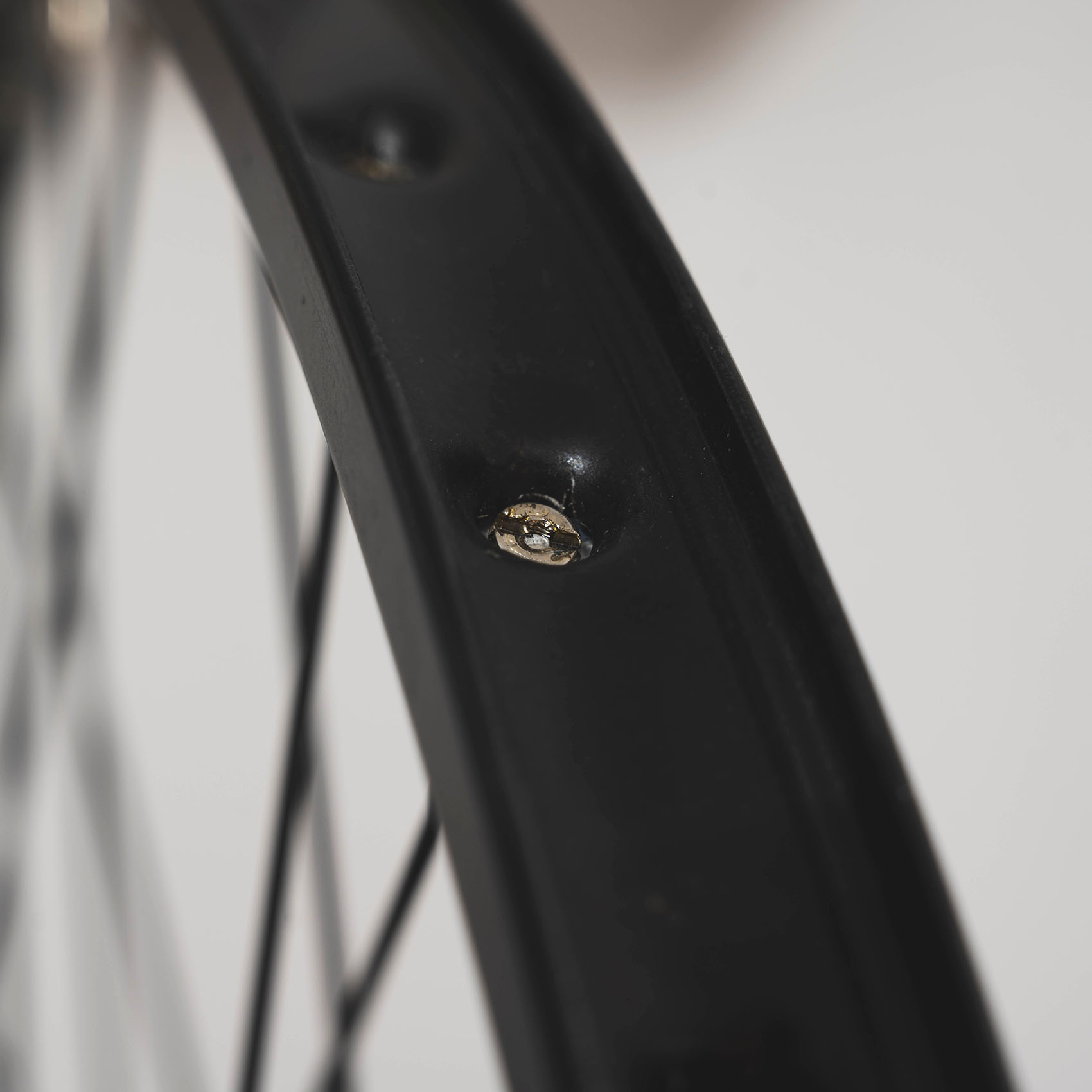
“What is the ERD of a rim? First, it is not the diameter where the tire fits in the rim, nor is it the inner diameter of the rim hoop. The ERD is that point in the rim where the end of the spoke sits (given that we have spokes of an ideal length).“

And from the standpoint of an algorithm behind a standard spoke calculator, they have a strong case here. Every spoke calculator requires you to enter such ERD dimension they are referring to above and, again, it is defined as the diameter of the circle through the end of the spoke threads.
Following that definition, we have to take into account also the remaining spoke thread length above the nipple bed section inside the rim, and here things start to become a little more complicated.

In the lower-end wheel market, wheels are generally by default assembled using standard brass round-head nipples. It is not uncommon that to provide the rim ERD for such nipple type used, manufacturers usually add up to two millimeters to the nipple bed section and state that as the ERD of the rim. Moving in the direction towards the higher-end wheel market we see a switch not only in nipple material (aluminium) but also in different spoke shapes like Squorx, Double square (DSN), or Prolong nipples. As such, nipple ERD becomes a somehow elusive concept, as even long-head nipples don’t have threads evenly distributed, brand-wise.
For more information turn to my other blog article - Measuring rim ERD: How do different spoke nipples affect rim ERD measurement, where real-world measuring of the ERD using various spoke nipple types was performed in search of a difference in a total ERD measurement for 5 different nipple type variations. Results were not neglectable and one should consider it. Not to mention that a rim producer sometimes also expects you to use eyelets underneath the spoke nipples.

Knowing it all now, how can we even expect manufacturers, to account for all variables mentioned and publish ERD, that applies to us, wheel builders?
The nipple seat diameter (NSD)
What about rim manufacturers? Since I am just in the middle of creating a component database with valid measurements entered directly by component producers, I was able to obtain first-hand opinions on the matter.
Talking to the head of the European production from a renowned rim brand, rather than conventional ERD term, another measure - the nipple bed section across the rim diameter is the only real measurement when it comes to the rim itself. Rightfully so, as it is the only measurement that you can unbiasedly observe, measure, and report without causing any confusion.
He was talking about what I name the nipple seat diameter, the inner diameter of a rim where a spoke nipple lies. Since this measurement is insufficient from the standpoint of a spoke calculator, to get an industry-defined effective rim diameter, a wheel builder is required to add the remaining length of spoke thread past this nipple bed section.
As seen, although this measurement is inadequate by itself, at least it clears the confusion in this area and most importantly, it provides a clear context to a wheel builder for it to be used in a repeatable fashion in the future.
Below, find a screenshot of a long, yet detailed recommendation from a carbon rim producer regarding calculating effective rim diameter in regards to the nipple seat diameter. Having such data, you can certainly make use of online wheel-building dimensions for a spoke calculation in advance.

Where stands Spokecalc in all that
As a promotor of the wheel construction artisanry, through my blog articles, free spoke calculator, and wheel-building app, I try to pursue a high level of consistency in terminology and at the same time enclose explicit visuals that support it in the clearest meaning.
To address the complexity in this area, visual tools like concise technical drawings were introduced very early stage in the program. When adding a new rim component, the app user can in that manner store also remarks about the spoke nipple type used to get the measurement in the first place.
A sample of very detailed rim information including measurements such as effective rim diameter or nipple seat diameter can be viewed below and was taken as a screenshot from a new component database in the making inside the app.

Recently, also the nipple bed section measurement or the nipple seat diameter was added to the app. This feature proved fruitful, especially for rim manufacturers, that are at the moment adding components to the backend database.


Enjoyed this article?
Buy me a coffee to support my work!
Every coffee helps fuel more content like this!
Final thoughts
What steps in coming toward a solution can be done? Are we closer to any real solution or will the trend of mistrust in online wheel building measurements persevere?
In trying to tackle this conundrum, the industry will have to unify the terminology used and at least communicate wheel-building measurements with a higher degree of clarity and consistency. Since rim manufacturers stand unified on providing the nipple seat diameter dimension, maybe the time has come also for spoke & nipple manufacturers, to make better visuals regarding thread length and position within spoke nipples produced, especially with the nipple bed section line in mind. Such data could serve well when adding the difference above nipple seat diameter to get the effective rim diameter.
Either way, having also a stake in the game, trying to achieve component database myself, at least now the reader knows what standards we are striving for and can expect them to be met if such a project succeeds.
Enjoy wheel building.
About author

Aljaž Trenta
Author and founder"As a cycling enthusiast, bike mechanic and self-taught web designer, combining several of my passions and skills to build SpokeCalc was a great fun for me."